

You check your account in the morning and find a trade closed at its stop loss overnight. The chart shows price never came near the stop. The candle is quiet, the move is tiny, and yet the trade is gone.
Look at the time on the closed trade. If it is a few minutes either side of the daily rollover, the culprit is almost certainly the spread, not the price.
Every trading day the forex market passes through a short window where liquidity thins out and spreads widen sharply. A trader asleep at home is rarely affected. An EA running around the clock on a VPS meets that window five times a week. This post explains what happens, which strategies it hurts, and how to protect them.
What the Daily Rollover Is
Spot forex has no official close, but the market treats 5pm New York time as the end of one trading day and the start of the next. At that point:
- Positions held over it are rolled to the next value date, and your broker applies swap (overnight financing), as a charge or a credit.
- Liquidity providers reset. Many banks and market makers pull or widen their quotes for a few minutes as their systems roll over.
- The market is thin. New York has finished its day, and the main Asia session has not yet started.
The result is a spread that can be several times wider than normal for a short period, typically for a few minutes and sometimes longer on less liquid pairs, metals and indices.
📊 Key Stat: 5pm New York time is 21:00 UTC during US daylight saving time and 22:00 UTC the rest of the year. On the many brokers whose server clock runs on GMT+2 in winter and GMT+3 in summer, rollover lands at 00:00 server time all year.
Because the time in UTC moves with US daylight saving, an EA with a hard-coded time filter can drift an hour out of place twice a year. Our post on daylight saving time and EA trading hours covers that, and the guide to broker server time vs your VPS clock explains which clock your EA is actually reading.
Why a Wider Spread Hits Stops That Price Never Touched
Charts in MT4 and MT5 are drawn from the bid price. But not every order closes on the bid:
- A buy position closes at the bid. Its stop loss triggers when the bid falls to it.
- A sell position closes at the ask. Its stop loss triggers when the ask rises to it.
When the spread widens, the ask jumps away from the bid. The chart, drawn on the bid, barely moves. A short position with a stop a few pips above the market can be closed by the ask alone, and the candle shows nothing.
The same applies to pending orders. A buy stop or buy limit triggers on the ask, so a spread spike can fill an order that the chart says was never reached.
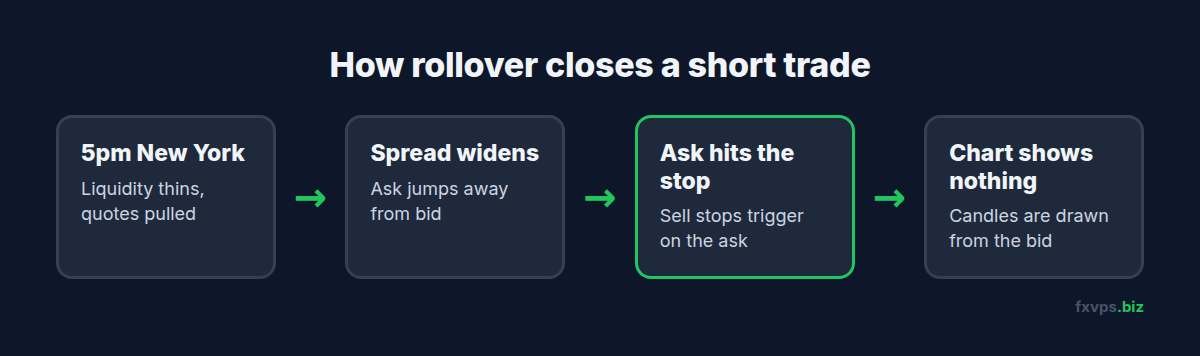
⚠️ Warning: A sell trade with a tight stop is the most exposed position at rollover. If you see short trades closing at their stop loss at the same time every few days, check the spread at that moment before you blame the EA’s logic or the VPS.
Which EAs It Hurts Most
- Scalpers. A strategy targeting a few pips cannot absorb a spread that is suddenly several times wider. Entries during the spike start the trade deep in loss.
- Tight-stop strategies. Anything with stops close to the market, especially on the short side.
- Grid and martingale EAs. A grid that opens new levels at fixed distances may add positions at poor prices during the spike. See grid and martingale EA VPS requirements.
- Mean-reversion EAs that trade the Asian session. Many start trading right after rollover, exactly when spreads may still be wide.
- EAs that trade every tick without checking the spread. If the EA does not look at the spread, it will trade into whatever the market offers.
Swing and trend EAs with wide stops are rarely affected. A few pips of extra spread do not matter to a trade with a stop 80 pips away.
How to Protect a Strategy
1. Use a Maximum Spread Filter
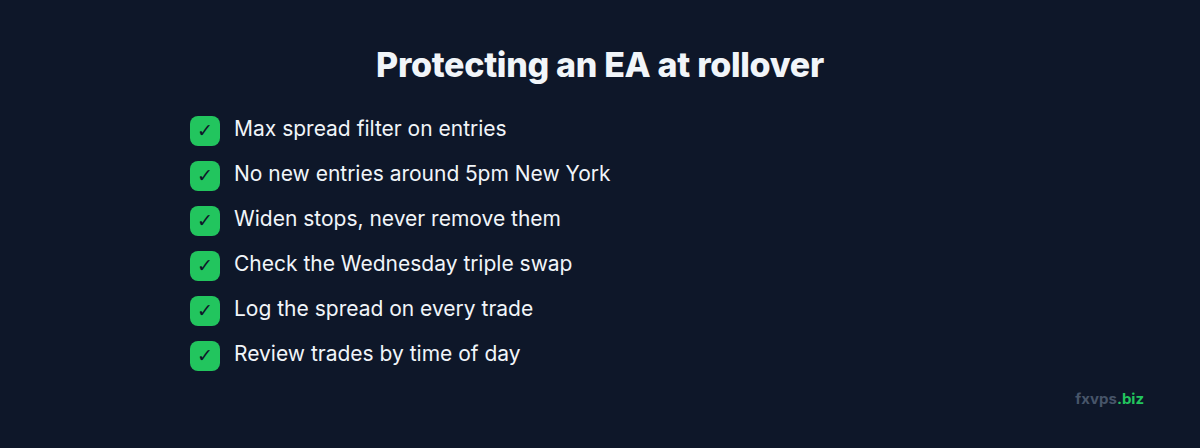
Most commercial EAs have an input such as “Max Spread” or “MaxSpread”. The EA checks the current spread before entering and skips the trade if it is too wide. Set it to a value a little above the normal spread for the pair at your broker, not the advertised minimum.
If you write your own EAs, the current spread is available as MarketInfo(Symbol(), MODE_SPREAD) in MT4 and SymbolInfoInteger(_Symbol, SYMBOL_SPREAD) in MT5, both in points.
2. Add a Time Filter Around Rollover
Block new entries for a window around rollover, for example from 15 minutes before to 30 or 60 minutes after. Base it on the broker’s server time, which is what the EA’s time functions return, and remember the daylight saving shift.
3. Move Stops Out of the Way, Not Off
Some traders remove stop losses at rollover to avoid spikes. That trades a small, known risk for a large, unknown one. If a strategy keeps getting clipped, widen the stop slightly or skip entries near rollover instead.
4. Watch Wednesday
Many brokers charge three days of swap on forex positions held over Wednesday’s rollover, to cover the weekend. Some instruments use a different day. Check your broker’s swap schedule if your EA holds positions overnight, because a triple swap on a large grid can be a meaningful cost.
5. Log the Spread
Have your EA print the spread when it opens and closes a trade. After a few weeks of logs you will know exactly how wide your broker’s spread gets at rollover, and you can set the filters from data instead of guesses. Our guide to reading MT4 and MT5 log files shows where those lines end up.
💡 Tip: Put a spread indicator on one chart per pair you trade, and look at it once around rollover. Seeing the spike for yourself makes it much easier to pick sensible filter values.
What a VPS Can and Cannot Do About It
A VPS does not change your broker’s spread. The quotes come from the broker, and every client sees the same widening, whether they are on a home PC, a broker’s free VPS or a server in the same datacenter.
What a VPS does change is exposure. On a home PC that sleeps overnight, your EA might never be running at rollover. On a VPS that runs 24/7, it is running at every rollover, every trading day. That is a good thing, because your strategy is working through Asian hours too, but it means the filters above stop being optional.
The other thing a well-placed VPS gives you is accurate timing. If your EA’s time filter is meant to stop entries at a set server time, a low-latency connection to the broker’s server means the EA sees the price feed, and the spike, as it happens. See slippage, requotes and VPS latency for how latency affects fills more generally.
✅ Best Practice: After moving an EA to a VPS, review its first two weeks of trades by time of day. If losses cluster around rollover, add or tighten the spread and time filters before you add more capital.
Recommended FXVPS Plan
Spread filters and time filters cost almost nothing in CPU or memory. Choose the plan for the number of terminals and EAs you run:
- Core ($29/mo, 2GB RAM, 1 vCPU): one or two terminals running a few EAs.
- Pro ($39/mo, 4GB RAM, 2 vCPU): several terminals, or scalpers that process every tick on many pairs.
- Scaling ($79/mo, 8GB RAM, 4 vCPU): many terminals or heavy Strategy Tester work alongside live trading.
Pick the location closest to your broker’s trade server. Compare plans on the pricing page, or start with the $2.99 7-day trial.
Frequently Asked Questions
What time is the forex daily rollover?
5pm New York time. That is 21:00 UTC while the US is on daylight saving time and 22:00 UTC otherwise. On brokers that run their server clock on GMT+2/GMT+3, it is midnight server time.
Why was my sell trade stopped out when the chart never reached my stop?
Sell positions close on the ask, but charts are drawn from the bid. If the spread widened at that moment, the ask can reach your stop while the bid line stays well below it.
Will a faster VPS stop rollover spread spikes?
No. The spread comes from your broker’s liquidity, and it widens for everyone. A VPS keeps your EA running and close to the server, but the protection comes from spread and time filters in the EA.
Should I turn my EA off every night at rollover?
Usually there is no need. A max spread filter and a short time filter around rollover do the same job automatically, and your existing positions stay managed.
Why is swap sometimes three times larger on Wednesday?
Many brokers apply three days of swap on forex positions held over Wednesday’s rollover to cover the weekend settlement. Check your broker’s specification for each instrument, because some use a different day.